Showing posts with label sociological imagination. Show all posts

Monday, July 14, 2008

Falling under the spell?

Ever notice how easy it is to find a particular view about the world utterly convincing? How we tend to adapt particular attitudes, some of them passionately and thoroughly, and at times find ourselves alienated from our own potential to understand another's viewpoint? Like finding ourselves at the driving end of an ideological spear, we suddenly realize we are defending a view, exploring how it works itself out in the real world. Take race and gender as an example; you notice how it permeates society, so you begin to (if it has been sufficiently imprinted on you by the university, or a particular interest of yours), see how it all plays out. You play the conquistador of equal rights, the bringer of multiculturalism. Seeing a real problem, a part of you sympathizes with the efforts, and wishes to play a part in the on-going war "against" ignorance, injustice and inequality. 

Or, in the case of the new atheists, part of you actively takes on a personal effort to immerse yourself in rationalist thought, watching dialogues between the greater ideological spokespeople, reading books and joining forums. You identify with the cause. Your forum tag becomes Dawkins quotes or Sam Harris, or any particular rationalist for that matter. Your identity, at this point, has immersed and linked itself entirely, or at least strongly with the movement, the effort, and the ideas involved.

In both of these cases, we allow ourselves to be strongly shaped by our passionate interest for a subject that we agree on. It seems natural for humans to bind together and identify with groups, be they larger or smaller. Yet it also seems at least a little dangerous in that by giving our minds over to be, in a sense, conditioned by an ideology (fanatic or not) is to limit our ability to understand another. By building the mind for specific tasks, we allow it to be less open to the receptivity of others (Not always, but frequently).

I find in many of the debates online, no matter what particular argument is going on, both sides fail to make the jump to a common ground in which one begins to thoroughly understand the other. Mistakes in interpretation, or simple strong identification with a viewpoint clouds the debaters judgement so that he or she may often miss a critical and interesting point about the "opponent." On the same token, the debater may even make poor arguments based on not thoroughly seeing what the oppositional view is. The fact that we disagree, conceptually, is not something that can be avoided. It goes almost without saying that to disagree is almost natural for us, but the inability to perceive another's attitude, to see through their perspective is something that is so far and few between, yet so important as the information age progresses. Unless we really do wish to see fragmentation, it's important for us to accept that perhaps we cannot entirely understand another's view, but maybe that is not necessarily important. Even agreeing or disagreeing, it may seem, may not be terribly important - save some vital issues and decisions.

In fact, that's the main point trying to be made here: Our agreements or disagreements, our theories and attitudes and ideologies we often follow are more about identification, emotional attachment and willing self-conditioning rather than objective "arguments" or clearly grounded perspectives.

Our ideas are ingrained into our psyche. They are rooted in our conscious and our unconscious, our battlefield, or playground of concepts in which we identify, and this occurs through various environmental and internal factors. The more we understand it's less about "I disagree!" and more about, "I identify strongly with this concept, and since this is who I am, I must defend myself!" We essentially allow our conceptual mind and emotional unconscious to continually shape our identity through time.

Perhaps more often than not debate is little more than ego battling ego, identity versus identity, using the other's defeat to build up your own. In many cases, our interests are sincere. They are not outright selfish, but to observe how we identify with a particular cause, it would greatly help us to not be so blinded by our own belief systems, and so arrogant with others.




Sunday, February 10, 2008

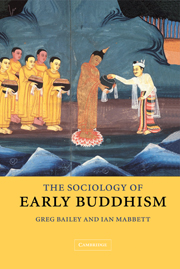
Reading "The Sociology of Early Buddhism"


So, while browsing links after searching google for "sociology, buddhism," this book came up. Being a sociology major, and very interested in how sociologists approach (if they do...) eastern contemplatives, I was excited at the discovery of "The Sociology of Early Buddhism," by Greg Bailey and Ian Mabbett. I browsed through the pages and started reading the first 15 (As they skip a few after that, insisting you buy the book to read it). At any rate, they began to discuss an apparent "problem" in understanding how and why Buddhism arose in ancient India. I had some trouble understanding what the problem was until they wrapped up the issue in a single paragraph (A rare treat for scholarly books):

"...Buddhism to have been something which, in its origin, it was not. In its origin it was a message for those who wished to forsake society, abandoning everything. It was not a rationale for the ambitions of holders of power and magnates. The gap between the austere ascetic impulse and the needs of expanding urban kingdoms is great indeed."


They continue to re-emphasis this point, sometimes in short paragraphs, other times in long, drawn out pages. Alright, well fair enough point, BUT wasn't Buddhism from its very start, a practice of the "middle way?" In other words, it wasn't about extreme abandonment or extreme indulgence. Have these authors included in their analysis, an understanding of Buddhist teachings? Or are they scratching at surfaces (Historical context, sociological concepts, etc). The more I seemed to read, the more I felt that the authors were setting up a false polarization of city vs. rural, ascetic vs. king. A book that helped me realize that this wasn't a centralized issue in understanding how Buddhism arose was Karen Armstrong's "The Buddha." Although her book is a little heavy with info and terminology, she writes the story wonderfully and really helps the reader understand how it all began.

The beliefs of the people at that time were ripe for a practice that would liberate themselves from "dukkha," which stemmed from a belief that suffering wasn't just in this life, but in others as well. You lived many lives and what you did here and now was a result of your own actions. At any rate... There were many different schools at that time, and Buddha himself wandered through 'em. India was ripe with a desire for liberation. This is somewhat of a cultural context, and C. Wright Mills' "sociological imagination" calls us to really try and walk in their shoes to understand it.

And second point, just scratching the surface of this book, did they review what the Buddha's own understanding was? His own teaching professes that one could achieve a "transpersonal" state of awareness in which one would be liberated from all objects that arise - whether it be another human being or a tree, or even a hot meal. But, having gone through his own testing, he realized one could not jump to an extreme. It wasn't a matter of "rejecting" society outright and completely, but embracing all things by not being attached to them. This principle, if you will, made Buddhism strongly appealing. It helped Buddha see through his own ego, more easily connect with his listeners and monks, and sway even the greatest of kings (Which, mind you, were also heavily religious). If you want to understand why Buddhism is appealing, you can't reject the essence of Buddhism itself. You can look at the historical context, the economic context, the sociological context, but feel free to dive into the teaching itself and explore what the meaning could do to a society that was ready and willing to explore good wisdom.

Alright, the rant review is over. If I can get through the rest of this, I'll try and see if there is anything I was dead-wrong about. So far though, I'm just a wee bit disappointed.

Blogging List

Followers


Live Traffic