Wednesday, February 13, 2008

Wonder


For you nerds out there (I guess - is a sociologist considered a nerd?) I'd just like to take a moment to reflect on my chosen major - Sociology. I have been taking classes for about two semesters now, and hopefully am gaining somewhat of an idea of what it's all about.

What is it, essentially? The study of the human collective. It's psychology, plural. Heavily tied into anthropology (that's very similar, with an empirical twist). Since I'm starting this major late into my college career, I'm actually going backwards and taking the introductory class this semester. We're learning the basics: how to do research, research ethics, culture, class, economics, Marx and Weber - all that good stuff.

Now, in my more particular socio classes, we seem to be focusing on these general topics:

1. Class Struggle
2. Gender
3. Globalization
4. Statistics
5. Suffrage
6. Race!
7. Gender!!
8. Class!!

Yes. Something definitely repeats in that list. We are heavily interested in, it seems, class and gender struggles throughout the world. How do the oppressed battle the oppressors? How does matriarchy struggle for a presence in patriarchy? How does race bias affect societies? It seems like, in other words, we're going over the major developments of the last century: gender, class, and race. These are really important issues because they are still issues. In many of my classes, the professors urge us to try to understand the delicate and complicated problems we face, even in the industrialized world. All in all, I'd give the focus a hearty B+.

The only thing I would really like to see more of, and so far am not, are other issues that may be harder to distinguish if we're looking on the surface. It takes a little digging, and a little remembering - but whatever happened to wonder? Or C. Wright Mill's "Sociological Imagination?" I don't want to sound idealistic, but can't we enchant our research with this wonderful tool? We have a great set of lenses to utilize: empirical research, statistics, data, sociological terminology. But what of wonder, adventure, thinking outside of the box? From dabbling into sociological books and talking with my professors, it seems they too are quick to admit you will not find such a spirit hidden readily in scholarly jargon. 

In fact, one of my professors even admitted that many books often tend to be a show of intellectualism over any honest, heartfelt questions. So I ask this one: Why can't we wonder? The answer of course, is redundant. Of course we can! There are a few gems in sociological research (Sidewalks) which attempt to narrate the research and make it accessible for everyone to learn from. It's in this spirit that I guess I am writing, too.

And in that case, let me wonder a little with you. These questions, right now, I'd like to ask without imposing concepts, and thus a bias:

1. What makes us tick, really? Not just economics, biology- those are a part of it. But really, what makes us tick?
2. What fundamental assumptions to we use to create how we see our realities?
3. Or even, can our basic assumptions about the world, and our relation to it affect every aspect of our reality - from individual actions to entire civilizations?
4. What discoveries has wonder brought us?
5. Because we believe we are born into the world, and not out from it - does this make a difference? Can it describe why things are the way they are? (Not in good shape for civilization, it seems.)
6. Let's allow ourselves to just wonder, and see what arises.


These and so many questions have arisen during my classes, but alas - they are never 'satisfied' or rather, no meaningful answer is given. To add to the starting point of criteria in our classes, I'd love to see us crack open Alan Watts' book, "Man, Nature and Woman." It explores our fundamental assumptions about humanity that run deep into culture, history and pour out in the present. The belief that there is a "self" and "other" for instance, creates a duality that seems to birth every opposite in the cosmos. These points, risen by Watts and many eastern philosophers (and sociologists in their own right), could do wonders for helping us understand ourselves, singular and plural. Why not start sailing the inner-cosmos, as well as the outer? To borrow the shamanic label, it's time for sociologists to embrace the psychonaut. 


Sunday, February 10, 2008

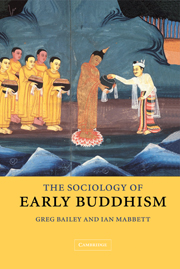
Reading "The Sociology of Early Buddhism"


So, while browsing links after searching google for "sociology, buddhism," this book came up. Being a sociology major, and very interested in how sociologists approach (if they do...) eastern contemplatives, I was excited at the discovery of "The Sociology of Early Buddhism," by Greg Bailey and Ian Mabbett. I browsed through the pages and started reading the first 15 (As they skip a few after that, insisting you buy the book to read it). At any rate, they began to discuss an apparent "problem" in understanding how and why Buddhism arose in ancient India. I had some trouble understanding what the problem was until they wrapped up the issue in a single paragraph (A rare treat for scholarly books):

"...Buddhism to have been something which, in its origin, it was not. In its origin it was a message for those who wished to forsake society, abandoning everything. It was not a rationale for the ambitions of holders of power and magnates. The gap between the austere ascetic impulse and the needs of expanding urban kingdoms is great indeed."


They continue to re-emphasis this point, sometimes in short paragraphs, other times in long, drawn out pages. Alright, well fair enough point, BUT wasn't Buddhism from its very start, a practice of the "middle way?" In other words, it wasn't about extreme abandonment or extreme indulgence. Have these authors included in their analysis, an understanding of Buddhist teachings? Or are they scratching at surfaces (Historical context, sociological concepts, etc). The more I seemed to read, the more I felt that the authors were setting up a false polarization of city vs. rural, ascetic vs. king. A book that helped me realize that this wasn't a centralized issue in understanding how Buddhism arose was Karen Armstrong's "The Buddha." Although her book is a little heavy with info and terminology, she writes the story wonderfully and really helps the reader understand how it all began.

The beliefs of the people at that time were ripe for a practice that would liberate themselves from "dukkha," which stemmed from a belief that suffering wasn't just in this life, but in others as well. You lived many lives and what you did here and now was a result of your own actions. At any rate... There were many different schools at that time, and Buddha himself wandered through 'em. India was ripe with a desire for liberation. This is somewhat of a cultural context, and C. Wright Mills' "sociological imagination" calls us to really try and walk in their shoes to understand it.

And second point, just scratching the surface of this book, did they review what the Buddha's own understanding was? His own teaching professes that one could achieve a "transpersonal" state of awareness in which one would be liberated from all objects that arise - whether it be another human being or a tree, or even a hot meal. But, having gone through his own testing, he realized one could not jump to an extreme. It wasn't a matter of "rejecting" society outright and completely, but embracing all things by not being attached to them. This principle, if you will, made Buddhism strongly appealing. It helped Buddha see through his own ego, more easily connect with his listeners and monks, and sway even the greatest of kings (Which, mind you, were also heavily religious). If you want to understand why Buddhism is appealing, you can't reject the essence of Buddhism itself. You can look at the historical context, the economic context, the sociological context, but feel free to dive into the teaching itself and explore what the meaning could do to a society that was ready and willing to explore good wisdom.

Alright, the rant review is over. If I can get through the rest of this, I'll try and see if there is anything I was dead-wrong about. So far though, I'm just a wee bit disappointed.

Weird Mars: Civilization and Apocalypse?


Did Mars once harbor a lush organic landscape, with civilizations that erected epic-sized pyramids? Could a catastrophic collision with a meteorite or some other large projectile in space, have decimated Earth's sister planet and left it a cold, barren red wasteland? Sounds amazing! Is it true? This team of researchers and scientists raise the questions about Mars, and demand for NASA to investigate strange evidence that would support these "crazy" claims. From bizarre tree-like shapes to strange pyramids and structures that resemble built structures, they investigate the intriguing possibility of a former civilization on Mars. That's all I have to say, let the conference speak for itself. If you're a space-geek like me, sit down, have a snack and enjoy the slideshows - and let me know what you think: Could there have been life? How could this effect us earthlings?

Google Video: Press conference about life on mars

Monday, February 4, 2008

"Change the Guard" - A Call to End Political Dynasty

A new blog by Lance Garret Steagall labeled, "Change the Guard," thunderously raises a point that has not been raised enough in the presidential race: The fact that two families have been on the top for the past 20 or so years. Bush, then Clinton, then Bush, and now Clinton again? So where is the change?

A brave citizen asked this question to Hillary, and she danced around the answer with usual political eloquence:

CLINTON: Well, as I have often said, I regret deeply that there is a Bush in the White House at this time. (Laughter.) But I think that what's great about our political system is that we are all judged on our own merits. You know, we come forward to the American public, and it's the most grueling political process one can imagine. We start from the same place. Nobody has an advantage, no matter who you are or where you came from. You have to raise the money. You have to make the case for yourself …

And, you know, it did take a Clinton to clean after the first Bush, and I think it might take another one to clean up after the second Bush. (Laughter, cheers, applause.)

It's shocking, no, disconcerting to hear little concern with this fact. Is she an agent of social change? Or is she a way to manage and continue the status quo? Is she truly just like the rest of us, the "same place," or is she privileged on the top?

Steagall writes, 

In saying "nobody has an advantage, no matter who you are or where you came from … you have to make the case for yourself," she denied the advantage of having a former president, still revered by much of the Democratic base, actively campaigning on her behalf. When Bill said choosing Obama is "rolling the dice," he proved that, in fact, you don't always have to make the case for yourself. When Hillary sent her husband out fund-raising, she proved that you don't "have to raise the money" yourself


It's very clear that she has every advantage over Obama - and this in itself is not a bad thing. Nobody ever said politics was fair. Though, I'm trying to make more of a case about privilege, which both Bush and Hillary have.

Steagall continues,
Every Bush and Kennedy in politics makes it clear; if you're a member of American political royalty, you've got a jump-start.


Her supporters can argue over the degree to which she has benefited, but they cannot argue over whether or not she has benefited. Hillary did not start from the same point as her competitors, she did not make her case by herself, and most important, she has no claim to change in this election.

Thirty years of the same two families in the White House is enough. It's time to change the guard.


Yes! Could not have said this better, and I'm glad someone out there is articulating it so well. I have never been too attached to principles and ideals, perhaps due to my own social hermitage, but there is something very wrong in allowing a virtual dynasty, blatantly obvious to an increasingly apathetic people, to continue. Hillary promises universal health care, while Obama does not. Is this really so? And how can we trust her? We know for certain she openly endorses and encourages her association with interest groups- and a majority of these interest groups are not interested in 'the people,' but their own financial benefits, and have been the source of resistance of universal health care in the U.S. for decades. Meanwhile, Obama is better at bring different social groups together and allowing compromise. His integrity is also steered at least a little more toward the people. As a sociologist, I find this sort of trait, or characteristic very important for a world leader. If our nation is truly "for the people," why are we continuously electing a small few to run the country, who are honestly looking after their own interests over ours?

I suppose this rant should make one final point: It's a shame it has come to this: Clinton vs. Obama. Kucinich was a worthy candidate who was slowly and cunningly pushed out from the spotlight by media, interest groups and political enemies (Not to mention Ron Paul was not mentioned once last night on Fox News). By endorsing Obama, am I just giving into the political game? Who knows, but I guess I'll leave it at that, and try to take some action, because it is usually better than none at all in the political world. As a side note, I would love to see how the Taoist concept of non-action can be integrated into modern politics. Hmm, more to come!

Peace, Being,

Shaman Sun

Sunday, February 3, 2008

Putting It In Perspective

Congressman and candidate Ron Paul has often mentioned putting the middle-eastern situation into perspective. What would happen if we were being occupied? What would happen if China was on our soil, using our resources? How would we react to nearly half a century of foreign occupation? Well, J.L. Bryan has written a fake timeline to show you just how you would feel. 


He opens with,

This is for anyone interested in understanding what American foreign policy has done to people in Iran.  (For simplicity's sake, I have combined the roles of the USA and the UK, as the USA was assuming control of the former British Empire at this time.)

Sure, it's just a switch - but it makes all the difference. I recommend that this is shared with folks and friends, just so we can really appreciate the importance of perspective.


Top 4 Writers Who Should be In Classrooms

Even though modern education can easily stuff our minds to the brim with intricate servings of "thinking critically," we never seem to apply that knowledge to ourselves. To top it off, most of the education we learn here in the West is heavily euro-centric, taking years to update and embrace new modes of thought. So, what if education were to begin to assist students in self-knowledge, and explore different worldviews that radically contrast, perhaps at surface level, traditional western values? What if east and west met? And then, what if east, west, north and south all found a congregation in the classroom, providing a mirror of both self-reflection and knowledge in the classroom? Man, we'd have one bad-ass educational system. Don't you think? This "top 4" is in no particular order, and I suspect it's the beginning of a long list of often-neglected writers would stir hours of conversation and thought in universities and high-schools across the world. In particular, the U.S. is in desperate need of new and dynamic education.

1. Alan Watts:

Why? Alan Watts is one of the few classical, yet easily accessible writers of eastern philosophy. Considering himself primarily an entertainer, his way with words, as well as book titles: "The Book: On The Taboo Against Knowing Who You Are"  provide both an intellectually stimulating and interesting read. He often gives readers an easy way into understanding the concept of the self, and how it is truly embedded into the world. We blossom out from it, not descend into it, he might say. This would provide students both younger and older, a freshly alternative view of the universe and their place in it. The often euro-centric classes would be shattered by a playful, creative and intelligent author. Watts is also the author of a huge collection of books, documentaries, lectures and essays. The possibilities here are endlessly fruitful.

2. Daniel Quinn:

Why? While Watts would help us ask big questions about who we are, Quinn will wittingly pose the deep, societal questions about aspects of civilization we take for granted. His work, particularly the underground classic "Ishmael," would force us to question the fundamental belief of civilization as a myth. Why are we? Why do we live like this way? Did human beings ever live another way? Aside from generating discussion, it would stir the cultural sediment and perhaps inspire a student or two to take action and openly explore alternate modes of living and subsistence. Quinn explores the lifestyles and culture of tribal societies vs. civilization. Tribal societies were, and still are, capable of a balanced and long life within nature, while civilization is always looming in the face of disaster, collapse. Quinn poses this theory: That perhaps our civilization was flawed from the very beginning, 10,ooo years ago. Check out his site.

3. Jiddu Krishnamurti: 

Author, philosopher, teacher and mystic. Why the pick? Krishnamurti is a system-buster, plain and simple. Systems are practical, but having a system buster is in itself healthy for a check-and-balance lifestyle, where nothing gets out of hand, and culture, let alone learning does not become like stagnant water. He raises the big, awkward questions: Why do we have religions? Are they escapes? What are ideologies but security fences to dwell within? He forces us, once again to question ourselves. It's not just a matter of thinking critically "out there," but what about "in here," in you and me? Self knowledge extends to world-knowledge. If we accept our insecurities and are in a constant process of self knowledge, then the lifestyles we will lead will reflect that. To Krishnamurti, the world's conflict is in fact an extension humanity's inner-conflict. In the library of books, essays and lectures he gave, the one resounding teaching was that of an inner revolution. 

4. Ken Wilber

Why? Well, he's been around long enough at this point to have both introductory books and in-depth and heavily detailed explanations of integral theory. He, like his predecessor Alan Watts, is deeply concerned with exploring the relations between east and west. What you will find is his ability to tie to the two together, finding east and west and west in east. Not only that, the cultivation and development of the integral theory provides a method and a philosophy that will help students see a "bigger picture." That is, see underlying patterns in seemingly different theories: psychology and art, sociology and quantum physics (Weird, eh? I'm sure there's something...), religion and science. The concepts and methods involved stimulate the analytical side, as well as the creative and explorative side of our minds. His works will raise deep questions, and ask students to ponder a world not only of horizons but of heights and depths. It explores consciousness in ways that are not usually emphasized. It takes the huge array of theories about everything, and makes a coherent "map" of them. Whether or not this map is effective will be up to the students to discern, but it is the vast library of material, of the general integral philosophy, following in the footsteps of the perennial philosophy, that will tickle the students minds and spirits. Not to mention, he is a fellow, at least part-time, blogger.


That's it for now. These list-blogs are fun to make, so anyone who reads this site should expect some more...


A Little to the Right

While browsing the blog-sphere, I came across this interesting blog by Dr. Martin Rundkvist: US Politics have no Left Wing. The key point I found here was the absurdity of American politics - to europeans, even our "liberals" are seen as conservative. We seek moderation, we do not promote change, not in the truest, most progressive sense. Only now are we seeing the possibility of a woman in office. Are we truly leading the world in the latest and greatest expression of democracy? And, are the democrats truly 'left,' or do they sway a little bit more to the right than we would like to think? This is what Dr. Martin has to say,

So, believe me, US politics don't have a Left. Looking at the presidential candidates, I am frankly appalled. None of them would be a viable politician in Sweden. They all support the death penalty, none advocates strict gun control and all make frequent mention of their religious beliefs in public. These are extremist stances. Not even the tiny Christian Democrat party mentions God publicly in Sweden, for fear of alienating the pragmatic rationalist majority.


Putting things in this context creates a drastic gap between our ideals about what it is to be democratic. In a sense, this forced me to think about the relativity of our politics. More and more, it seems we are standing more on the ground of loose myths about our country, instead of steady facts.

From a European perspective, US politics are an ongoing battle between the extreme Right and the middle Right. The Republican presidential candidates are really, really scary people in my view. So all of us in the world at large who live under the shadow of US political hegemony are holding our breaths, hoping that Clinton or Obama will make it into office. They're pretty bad, but the alternative would be unspeakably dreadful.


It is sad that it has come to this, but of the two, I'd say Ron Paul or Obama will have my vote. For one sound reason: integrity. The both of them have been pretty consistent, and do not play dirty politics like Clinton tends to. Not to mention the strange fact that two families have been running the country for the past 20 years: The Bushes and Clintons. This is rather more like a dynasty than a democracy. Just for the principle of it, I do not trust a small group on the top to simply pass around the presidency to the "privileged few." How come nobody is mentioning this?

Except for Mos Def on RealTime with Bill Maher. I think these questions shouldn't be considered absurd. If anything, let's explore the possibilities first, no? I do appreciate Bill Maher's work, but the one thing that gets to me is at times it seems he is too easily dismissive. At any rate, have a laugh and learn a lil':

Blogging List

Followers


Live Traffic