Nested here, On my pirch in the city, I watch the world spin around. Rested here, On my city step, I listen to the sound of Heaven and Hell, And all that is forgotten, In Between.
The school life is like a daze, where you can lose yourself in books and social activities. A few steps out the door and the world still plays the game of "becoming," with everyone busily working on one thing or another. At times it seems silly to watch everyone buzz around like bees going somewhere. Going, going, always going - but where? And why? I follow nonetheless, for a delicious flower to suckle life from, the act of becoming. I wonder sometimes if this is our grand myth, this act of becoming. If I write, it is in that state of wonder. That subtle watching we are all capable of doing, the eye that sees a life unfold over the years, is the eye that can most dispassionately, yet most fully and completely observe the act of becoming, without becoming itself. More and more these days, there has been a sense of "watching" my life instead of becoming lost in the story. The habit crystallizes, will it shatter?
Come come, Play pretend for a little longer, Your laughter, Your hatred, Your tears, Your drama, Let it unfurl most obviously, So that I, That little Witness, can play Audience. Come come!
I was just reading Alan Watts on the train today with my girlfriend, who we will call Siamese Dream. We were talking about how, no matter who you are reading, it seems that many of these teachers resonate with the same meaning, from Wilber, to Krishnamurti, to U.G. Krishnamurti, to Thich Nhat Hanh, to even Eckhart Tolle. Even those who disagree, who may have metaphysical or intellectual disparities, resonate the same understanding; that there is more than bickering, that there is a greater awareness, consciousness - or all pervading spirit in all things.
"Why is it that, with all of these teachers, nothing has truly shifted? You'd think that with all of these individuals, something would have changed by now in the general culture."
"True," she said as the Brooklyn train came to the next stop, "But it gets no coverage. The media chooses to ignore it."
She brought up a good point. No matter who we read, and how we read it, it is often very difficult to bring about change without the assistance of media coverage. Especially today. A minute later, after the train picked up again, I looked up to find a lady reading Eckhart Tolle. We smiled at the synchronicity, and continued reading.
"What's that?" My Siamese Dream asked, looking at a picture in the Watt's book. It was a picture of, literally, squiggly lines, or as Watts calls them "Wiggles." The universe, he points out, is just a bunch of wiggles. You don't know where it starts, where it ends, and nothing is outright cut and dry.
It is the "Net" or "Web" or "Grid" which we have imposed on the world which allows it to start to make "prickles" or straight edges. The wiggles are made sense of. Yet, even this "grid" is another image imposed on the world. The stars, he notes, are not perfect geometric shapes, but rather like drops of water splashed randomly across the sky. It is our minds that creates and maps out the universe, making "start charts" and grids to help us navigate. I looked around, at the subway train, at the buildings outside, the tracks, the cars, the roads, and didn't find one wiggle at all. The only wiggly parts, it seems, are the people themselves. We're quite Wiggly, as Watts points out, and with our minds we make "prickles" to shape the world and make sense of it. That's all right of course. Our brains are developed in such a way as to promote this. But if we are to truly transform, or at least be able to get along better, we have to understand inter-dependence on everything, and the very nature of "prickly" making vs. the natural wiggly world.
So that all really means - self knowledge. Understand your own being, how you come into being, who you are, and how you "are." Part of this is questioning and openly exploring your own nature, and your own assumptions about the world.
As we got off the train, we discussed the last lines read in Watts. One being - given infinity, all random things will happen. This myth explains away all 'meaning' behind life, existence, love, beauty, etc. And the bleakness of this theory is meant to be embraced, toughed out. We both eyed this scientific myth with a skeptical eye. I feel that it is better to be skeptical, to be open to the possibility of "randomness" being wrong, just as much as we are open to it being right.
Given enough time, would a monkey on a typewriter create Shakespeare? Even if they did, what would the gibberish be after it is finished? There seems to be more "consistency" in our consciousness, for me to outright embrace this example.
As we walked toward the school, we entertained one last thought: Although the theologians defend the faith in deeper, more meaningful ways - it is the stereotypical images of faith, it is the general mentalities that people embrace and utilize. As much as we like to look to the defenders of the faith, or any belief or system in general - we must not forget the general, surface levels, because they are what effect the culture, the consciousness, the collective, perhaps at an ironically deeper level than the deepest of theologies.
Bringing it to light, "Perhaps that's why these great sages haven't deeply affected us - because every shallow surface is shinier and more attractive, and the public takes the bait." They dare not take off the swimmies and dive deep. This doesn't make any kind of superiority in anyone who does, it just shows that, generally speaking, if we want change, it has to affect people on a massive, surface level - the media. A look at Kucinich is a great example. He is an excellent thinker, politician and has great plans for the U.S. Yet, the media willingly chose to discredit him, and then outright reject him. The effect? No coverage, no mass support, no voice.
To end on a good note, I have hope for the future, and am excited to see more sages getting a louder voice in a world that is increasingly filled with "white noise."
Check out what Alan Watts says about "Prickles and Goo"
The first blog entry here, not so long ago (last fall) talked about the possibilities of the paranormal. I guess this is just a continuation. UFO's, crop circles, alien abduction, exorcisms; all of these things used to tickle my imagination. Don't get me wrong! They still do. It's just that they no longer captivate me for hours on end anymore. I remember finding a quiet place at the library in elementary school. Beside me lay a pile of UFO, alien, and bigfoot books. Isaac Asimov also remained close to my side as I learned about each planet, each solar system and the future of space travel. I'd often tell other 2nd graders horror stories, alien abduction accounts and warned them that spirits could be everywhere, so watch out! Naturally, I didn't have too many friends after scaring half of them off. Those who stuck with me also seemed to share a flare for adventure and mystery. But anyways, all of this is really just me rambling about how much the paranormal genre has permeated through my life.
So this blog, every once in a while, will poke at that genre and see what happens. Take this for instance:
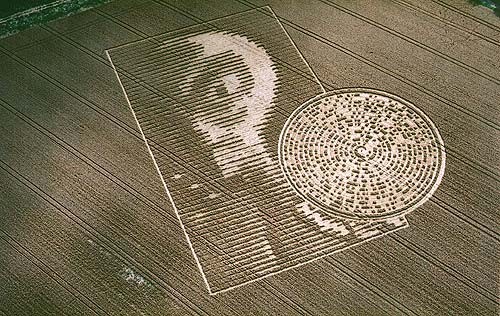
It's a little compilation of different crop circles. The intricacy is truly remarkable, and these things pop up quietly over night. On occasion, the owners of the property report seeing strange "Lights" dancing over the field, only to find massive and perfectly formed geometric shapes on their farm the next morning. According to Wikipedia, crop circles date as far back as the 17th century. Here is the story and the picture of the infamous "Mowing Devil."
Although some men have confessed to making these,
Doug Bower and Dave Chorley made their crop circles using planks, rope, hats and wire as their only tools: using a four-foot-long plank attached to a rope, they easily created circles eight feet in diameter. The two men were able to make a 40-foot (12 m) circle in 15 minutes.
The phenomenon itself can't be discredited so easily, as weird evidence begins to pile up that just doesn't make sense conventionally. For instance, the amazing intricacy of the crop circles, with perfectly formed geometric shapes, suggest that a simple wooden plank would not do the trick. If you take a look at the first image in the blog, of the alien holding a disc up towards the viewer - this is a real crop circle! Appeared overnight. There is something bizarre about this one, as it appears to have a "3D" effect. Considering the scale and the detail in creating this, either the hoaxers have created a new and elaborate system in which every shape is created in perfect geometric harmony, or something equally as strange is going on. To add to the mystery, many of these detailed crop circles, when examined under a microscope, have shown signs of microwave energy. That's right, as if the plants were pushed down by a microwave blast. Bizarre, no? I'm trying to find the source for this information. I saw it on T.V. a few years ago, and more recently it was noted in Daniel Pinchbeck's "2012; The Return of Quetzalcoatl"
So what does it all mean? Who knows. The crop circle phenomenon is not so much a problem as it is a mystery. Whoever creates these has mastered an art form, creating complex geometric symbols, meaning and mathematics in these works. They inspire thousands to wonder, and perhaps, for now, that is at least a start. If only the media would cease turning a stubborn eye from the mystery, and dabble in true blindness of the unknown. That's the great thing about all of these mysteries, they test our arrogance, and reveal to us our ignorance. They invite us to accept the unknown as something that we cannot necessarily master or know. They tempt us not to create new ideologies, but to reflect on how we often become trapped in them. At any rate, that's it for this paranormal journal. See you next time!
This is it folks! Fordham University has officially accepted KOSMOS as a club! We are now funded by the school to pay for our publishing. Awesome! Now calls for the heavy task of advertising. Fliers, fliers fliers, I say. We already have a few up in the main building. More to come. Any ideas for design? Any concepts for the journal? For anyone who just started reading or has been reading this blog, suggestions are welcome. Our first issue comes out in March. Our mission? Generally speaking, to bring each of the academic departments together under one magazine. Science, religion, philosophy, art, journalism, creative writing - whatever genre, whatever department, you are welcome here. We will also be exploring the edges of academia, and beyond. We are offering students a chance to learn about alternative knowledge, integral philosophy, and a creative and intellectual outlet. For those who are particularly spiritually oriented, we offer a channel for their voice. Come one, come all, you are already a part of the KOSMOS. As a bonus, we are designing the magazine itself after integral models. We're even having a Zen event this spring! Look forward to hearing more updates...
The labeling power of psychology can be mishandled, not only by intention, but by the very nature of labels, diagnosis and categories themselves. On the other hand, the positive aspects of knowledge enable the "knower" to see into things that may have before been mystified. For instance, knowing the terminology of an organ and the technical knowledge to operate enables a surgeon to efficiently handle procedures. But, can this same type of approach be used for the treatment of the whole human being, beyond his or her physiological body? In other words, the classical psychological approach is to learn how to map out the mind like an organ, labeling each mental state, thought, emotion and experience to its appropriate category. The mind, abstractly, is a vast network of logical equations and variables, in which the psychologist, or psychiatrist maps out and diagnosis. Although well researched and carefully thought out through rigorous scientific investigation, it is only so useful. For, the inner experience of "who I am" is dramatically different than the objective operating table. To the "me" inside, the experience of self is dynamic, organic and very much alive. Every day we are flooded with emotions, ideas and experiences which call for an understanding of "innerness." So, to approach the human being as merely the "outer" organs in which the self is hidden within, like a ghost in the machine, automatically creates a gap between the psychologist and his patient. This distance is perhaps unnecessary, as the psychologist himself is a human being, with an "inner" too. Is it possible to thus use an inner science to compliment the outer? Perhaps it is an assumption of our time that, to be scientific one must view the world through steel microscopes, to reduce the world to "outers." This would leave the human being missing quite literally half of his being, and this forgotten "inner" is perhaps just as important as the "outer," for it animates existence with the experience of life, the mysterious awareness we all have. The body and brain, in this sense, is the seat of the soul, or the self which is the hidden observer within us all. Without this, we are merely empty bio bags without a self. In the medical world, such a description would be called brain-dead. What is trying to be emphasized here is the need for an integrated view of our inners and outers.
So the problem of the psychologist is also the benefit. Her labeling power enables a field to work with, operating on the "inners" from the outside with a neat map to navigate with. To make this more tangible, take the example of a patient and psychologist. He takes a seat in a comfortable chair, with wooden floors and a well-lit room.
Now, the patent is suffering from a stormy, emotional inner of ups and downs. The patient describes this as being out of control - extreme moments of excitement followed by crash and burn bouts of depression. There are no go betweens, the patient describes, and he loses "common sense," potentially able to harm himself and others. He has finally gone to see a psychologist in hopes to gain some peace and autonomy back into his life. Now, hypothetically, the man is not aware he is suffering the symptoms of what is commonly called bi-polar "disease." After listening carefully, the psychologist can infer that he is a classic "bi-polar."
She describes to him the diagnosis, the cause of which is often explained by chemical imbalances in the brain. This is a life long disease, she describes, you have to learn to live with it. She recommends him to a psychiatrist for medication.
Medications, such as Abilify, might be taken by this man, in order to regulate the ups and downs and smooth out their peaks. This diagnosis, classically, is the best they say they can do. Now, there is a limitation to this kind of treatment as much as there is a benefit. By labeling something, we give it a certain connotation. It shapes its reality for us. This can both serve to narrow something or to enrich our understanding of it. Writers in the west, such as Foucault, tell us of the empowering, and potentially containing power of knowledge. Jiddu Krishnamurti describe how once you give a title to something, all potential to truly understand has ceased. It has now become a dead thing, shelved, booked, recorded and stored away. What is required, he suggests, is the capacity to listen, to explore the territory before squaring it away in maps, systems and modes of thought. Only then is there potential to truly connect and understand, in the unlabeled, dynamic, organic nature that is the human being, and is life.
Suspending for a moment, this library of classical psychological criteria, "diagnosis" then becomes a less restricted move to connect with the individual in need. The lense of abstraction is lifted, and if we have let down our own boundaries for an instant, perhaps we would see a different view of the "bi-polar man." Perhaps, then, we will have a different explanation for what a mental illness actually is. Perhaps, the previous divide between the inner and outer is what has created such great mental stress and strain on the human being. Questions like this will be free to be explored in such a new paradigm of thought.
Let's say that after a lengthy description of his symptoms, the patient is then asked to explore the causes for them. Through a careful self-analysis with the psychologist, the patient discovers he is repressing emotional insecurities, tension, anger and anxiety - and these repressed aspects of his subconscious slowly bubbled up into the sever condition he is in now. The man gains inner-knowledge, or self knowledge, instead of just outer knowledge. He is thus dealing with an internal experience, learning to understand its sources, as well as an outward understanding of his physiological makeup.
Good health is not just the intake of diet, exercise and proper sleep, it is also the inner health, the mental, emotional and psychological state. A good model for psychology, then, would recognize the human being as a complex creature of both inners and outers, as intricate as the single flower, with biological systems that dance in dynamic, organic equilibrium.
It can be said that we would no longer treat the machine to get to the ghost inside, but see both as direct, experiential and tangible. William James knew this early on, beginning his own journey through "inner" world by stating, "We now begin the study of the mind from within."
Within and without, let us begin our study, and usher in the new paradigm of a psychology for a deeper, wider and more inclusive world.
I was reading an interesting website, Michael Teachings. It is generally considered a new-age revelation, where a being from a higher spiritual plain has 'channeled' its wisdom to us folks in the jungle. I know there is alot of criticism with New Age teachings, and I'm not sure if channeling is what they often describe it as, but I'm willing to be open to the possibility. While reading this site, I kept a healthy skepticism, but found some good teachings that truly resonated with Integral theory. For instance, the life of the soul, according to Michael, goes through levels. Five levels to be exact. In the beginning, "baby" souls are open to psychic powers, do not differentiate themselves much from their environment, and often are passive and cautious. It is even mentioned that "baby" souls resemble "old" souls in this way, but they are two very different stages of development. According to Michael, one must go through all the stages of development to get to the "old soul" stage, even though "baby" and "old" stages resemble each other. This struck me as a clear example of understanding the pre-trans fallacy. In this sense, the general philosophy of Michael is vertical. He also teaches a variety of 'horizontal' teachings. I find it interesting to note that the stages of the soul resemble spiral dynamics.
The middle stages are more violent, defensive, meme-war like and karma-collecting. "Young" souls thrive in "I do what I want" environments, and "Adult" souls thrive in mythical, rule-role environment. Interestingly, it seems that the "Mature" soul is one who is tied between worlds, who is beginning to think in new perspectives, to shake loose the bondage of mythic structure and embrace pioneering fields. They are the troubled geniuses, Michael says, who are disillusioned and attempt to make sense of the 'unknown' without just translating it into meme-wars. Sounds almost like 2nd tier structures in spiral dynamics, no? The beginnings of integral, the existential self, etc. To sum it up, 'Mature' souls are finally clearing out their karma, and letting go of the burdens accumulated from past lives. They are also beginning to be the 'self reflexive' type, understanding their own psychological issues.
At last, the "Old Soul," is one who has at last dropped a majority of the karmic bondage and emotional baggage. The old soul is described as one who resembles a physiological old person. They tend not to be noticed much, as their development is extending beyond this 'plain,' or in integralist language, resonating with transpersonal states. Because of this, they seem to resonate less and less with those who are still grounded in the more earthly, physical domain, and mental domains. That is, personal and pre personal. Because of this they are, in the most direct sense, in the spirit of Taoism, one who is simply content to just be, and let things occur naturally. There is less 'doing' and more 'being,' but an acceptance and understanding of both. The previous 'stages' may not like this, or even pay attention to 'Old' souls because they seem to embody the spirit of action through non-action.
So, what 'stage' do you see yourself in? They can of course be intermingled, intertwined, or transitory. Personally, I see myself as dancing between the Mature and the Old soul. Often I find myself attempting projects, trying to 'connect' or 'resonate' if you will with many communities. The Integral community, Zaadz, Gaia, Tribe.net, as some examples. Yet, it seems almost natural for me and my blogs to go under the radar, hardly noticed. I think after reading Michael's teachings on Old Souls, a part of me has come to accept that aspect as natural and possibly even good. A constant struggle for me, it seems, was getting involved and noticed in these communities. I always seemed to disappear between the cracks. Not to complain, but it definitely was a downer for me. Maybe if I accept the quiet that's around me, I can learn a thing or two from the silence and find a better way to resonate with others.
So, in that sense, I'll walk the old temple path, and not try to set up shop in market yet. Who knows who or what I will stumble upon. The stones are ancient here, and the temple falls gently into the forest's embrace. I have no dazzling community, nor podium to speak to many and with many, but that's alright. Every breath and leaf, flower and tree, being and non-being that is both seen and unseen, has a lesson to teach.
the horror
-
I AM A MACHINE THAT DOES NOT KNOW IT IS A MACHINE
AND THAT IS THE HORROR!
Steel nerves without sensation!
Circuits without a scream!
I produce oceans of l...
A Rebirth Into Infinity
-
11/16/2021: Heroic dose (7.377 grams) of psilocybin mushroom (Penisenvy).
I now have a new appreciation for the Buddhist teachings… Shinzen’s
hardcore dha...
Not so Gung-Ho this time
-
As predicted, I totally failed at keeping with the writing. In spite of the
enthusiasm and spirit of my previous entry, I let everything else get in
the wa...




 Posts
Posts


